The Halloween Candy Scare That Terrified the ’80s: Razor Blades, Poisoned Treats, and the Truth Parents Never Knew
SERPENTOR’S LAIR | THE NOSTALGIA FILES
The Halloween Candy Scare That
Terrified the ’80s
Razor blades. Poisoned sweets. A murdered little boy. How one true crime and a cascade of alarming headlines taught an entire generation to fear what was inside the candy bag.
By Adam Jared | Serpentor’s Lair | October 2026 | Nostalgia Investigates

THE MEMORY THAT NEVER LEFT
Remember that moment?
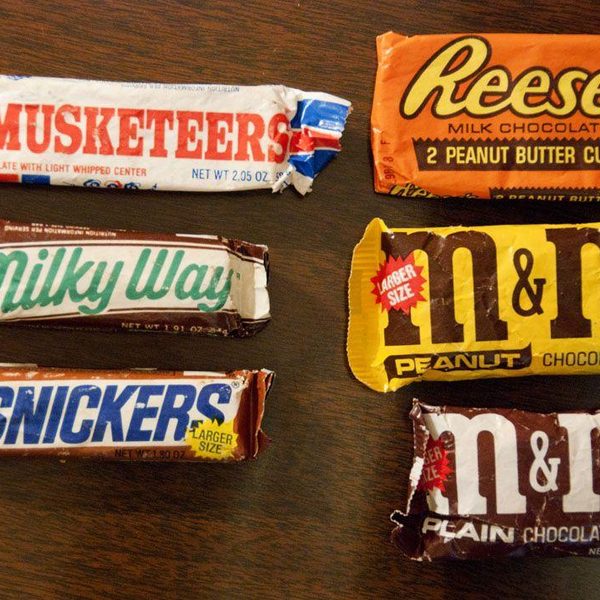
Your plastic pumpkin bucket was finally full. The porch lights were going dark. Somewhere in the kitchen, under the buzz of a fluorescent fixture, you tipped a mountain of sweets onto the table — chocolate bars, bubble gum, candy corn, maybe a sticky homemade popcorn ball.
But before you could claim your favorite piece, an adult delivered the rule every ’80s kid knew:
Not until we check it.
Wrappers were turned over. Apples were examined. Anything homemade or unsealed was viewed with suspicion. The most frightening Halloween story wasn’t playing at the movie theater. It was the one your parents told you about what some terrible stranger might have slipped into your pillowcase.
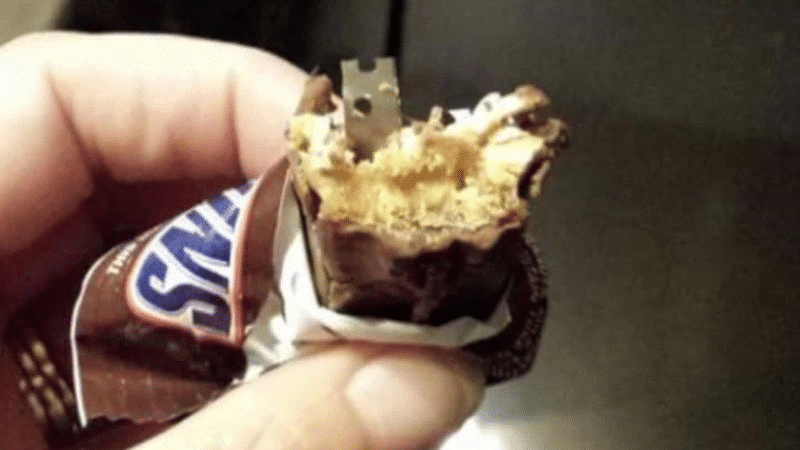
The story involved razor blades hidden in apples, pins buried in chocolate and deadly poison concealed inside candy. It sounded so widespread, so plausible, that many families treated it as an annual certainty.
But the documented history is startlingly different.
THE SHOCKING FINDING
The fear was real. The epidemic of murderous strangers handing out Halloween candy was not.

Before the ’80s, a Rumor Was Already Spreading
The image of the poisoned apple didn’t simply appear in 1982. It grew through the 1960s and 1970s, when stories about strangers harming children began circulating through neighborhoods, schools, newspapers and worried families.
There were isolated acts of genuinely reckless behavior. In 1964, Helen Pfeil of New York was arrested after handing out items including ant poison and dog biscuits to children she reportedly thought were too old to trick-or-treat.
Authorities did not regard the stunt as harmless, although no child was poisoned. The episode showed that irresponsible conduct could occur; it did not establish a nationwide conspiracy of murderous candy distributors.
A few years later, newspaper warnings about pins, glass, drugs and blades took on lives of their own. Each retelling made the anonymous villain seem closer.
You never saw the person responsible, never knew the supposedly poisoned house, but everyone seemed to know someone who knew someone.

The Real Halloween Murder That Haunts the Legend
OCTOBER 31, 1974 — PASADENA, TEXAS
Eight-year-old Timothy O’Bryan returned from trick-or-treating carrying what should have been the spoils of a happy night.
His father, Ronald Clark O’Bryan, had distributed oversized Pixy Stix to several children, telling them the candy had come from a house along their route.
Timothy ate one.
It contained cyanide.
He died that evening. Four other children who had received similarly contaminated candy did not eat it, and their lives were spared.
For a horrified public, the killing appeared to confirm the worst fears about Halloween.
But the investigation led in a very different direction.
Police found that Ronald O’Bryan had taken out life-insurance policies on his children. Prosecutors argued that the father had staged the poisoning as the work of an unknown Halloween monster while planning to profit from his son’s death.
Ronald O’Bryan was convicted of murder in 1975 and executed in Texas on March 31, 1984.
The date matters: his execution arrived in the very decade when Halloween candy warnings were becoming a familiar American ritual.
THE CASE THAT CHANGED EVERYTHING
The most notorious fatal Halloween candy poisoning was committed not by an unknown neighbor, but by the child’s father.
Timothy’s story deserves to be remembered as the tragedy of a real child — not simply as ammunition for a frightening legend. It is precisely because his death was genuine that the facts surrounding it matter so much.

1982: When a Nation’s Worst Fear Met Halloween
On September 29 and 30, 1982, seven people in the Chicago area died after taking Extra-Strength Tylenol capsules that had been deliberately laced with cyanide.
The crimes were not connected to trick-or-treating. Nevertheless, they unfolded just weeks before Halloween, at the worst possible moment for parents already hearing scary stories about poisoned candy.
The Tylenol murders proved that a product on an ordinary store shelf could be tampered with in a way the unsuspecting buyer could not see.
The psychological leap to Halloween candy was immediate. If an everyday medicine bottle was not safe, people wondered, why should a chocolate bar handed to a child by a stranger be any different?
The resulting precautions went far beyond family kitchens.
In Chicago, officials distributed about one million leaflets encouraging residents to give children money or small toys instead of candy.
Some communities around the country canceled traditional door-to-door trick-or-treating, while others suggested coupons, organized parties or alternate celebrations.
A holiday built around knocking on strangers’ doors suddenly felt deeply unsettling.

The irony is that the same consumer-product tampering crisis helped drive the emergence of the sealed and tamper-resistant packaging we now take for granted.
But in 1982, reassurance was in short supply.
Fear traveled faster than the facts.
Then “Dear Abby” Put the Warning in Black and White
If you were an ’80s kid, you didn’t have to read the newspaper yourself. Adults read it for you.
Safety reminders appeared in school conversations, local coverage and nationally syndicated advice columns.
On Halloween 1983, Abigail Van Buren — the famous “Dear Abby” — warned readers that a child could become seriously ill or die because of poisoned candy or an apple containing a razor blade.
Smithsonian later highlighted the column as a particularly revealing example of how a frightening possibility became repeated public advice.
An adult reading that warning did not need to be gullible. The Tylenol murders were fresh in memory. The O’Bryan case was real.
When authorities, newspapers and familiar columnists all emphasized the same danger, inspecting each Snickers and Tootsie Roll could seem like the only responsible thing to do.

The Professor Who Checked the Stories
In 1985, sociologists Joel Best and Gerald T. Horiuchi published a study in the journal Social Problems with a title that sounded like a Halloween horror movie:
“The Razor Blade in the Apple”
Instead of accepting the stories on reputation, they examined documented press accounts of suspected Halloween candy contamination dating back to 1958.
Best’s subsequent research made an important distinction. A report of a suspicious object was not proof that a stranger planted it, much less that a child was injured by it.
Claims were sometimes exaggerated, mistaken, or later traced to something other than a dangerous treat received on Halloween.
Best said he could not find a substantiated report of a child killed or seriously injured by a contaminated treat picked up while trick-or-treating.
This does not prove no one ever tampered with candy — scattered incidents and suspicious finds have occurred — but it challenges the idea of an annual wave of random attacks.
One widely repeated case illustrates the problem. In 1970, five-year-old Kevin Toston of Detroit died after ingesting heroin. Early reports suggested Halloween candy had been responsible. Subsequent investigation determined that the drug had come from within the family’s home rather than an anonymous trick-or-treat giver.
That quieter correction could not compete with the original nightmare.
WHAT THE RESEARCH ACTUALLY SAYS
No substantiated death or serious injury from a contaminated treat given by an anonymous trick-or-treat candy distributor was found in Best’s research.

X-Rays, Inspection Stations and the Ritual of Suspicion
Some hospitals began offering X-ray screening for candy as a community safety service.
The image was reassuring: a bag of treats placed under medical equipment, metal hidden inside suddenly exposed.
Yet researchers and radiologists raised doubts about the usefulness of routine screening. A scan might detect some metal objects, but it could not reveal poison or many drugs.
By then, the ritual itself had become part of Halloween. Parents checked every wrapper; children learned to surrender the candy bucket before taking the first bite.
For Gen X, this strange mix of freedom and fear is inseparable from the holiday: we roamed neighborhoods in cheap plastic masks and homemade costumes — then returned home for an inspection worthy of a crime lab.

So What Was the Real Danger?
None of this means parents should ignore common-sense food safety.
An unwrapped or suspicious treat should not be eaten; allergy precautions and age-appropriate candy choices also matter.
But the evidence points to a more ordinary Halloween hazard that deserves far more attention:
TRAFFIC.
A great many children walk unfamiliar routes after sunset on Halloween.
Research summarized by Best has shown that the risk of pedestrian injury is a more substantiated concern than the anonymous candy poisoner.
Visibility, crossing streets carefully and staying with younger trick-or-treaters are sensible precautions with clearer evidence behind them.
The Myth That Outlived the Decade
Today, the ’80s can feel like a world of faded Kodak snapshots, chilly October sidewalks, It’s the Great Pumpkin, Charlie Brown on television, Ben Cooper masks, and pillowcases so heavy you had to drag them.
We remember the chocolate. We remember the costumes. And, remarkably, we remember being told that someone might be trying to kill us with a piece of candy.
That is the hidden power of the razor-blade story.
It took several rare but disturbing real events, mixed them with the fear of strangers and gave an ordinary family ritual the weight of a national emergency.
The story did not need widespread evidence to survive.
It only needed one parent to say, “Better safe than sorry,” and another child to repeat the warning the following October.
The chilling twist?
The greatest threat to Halloween in the 1980s may not have been lurking inside a candy wrapper at all. It was a fear so contagious that an entire generation came to remember the legend as if it were an established fact.
“The candy was sweet. The story was terrifying. And the truth was far stranger than the rumor.”
BEHIND THE STORY: VERIFIED SOURCES
-
Joel Best — Halloween Sadism: The Evidence
-
Joel Best and Gerald T. Horiuchi — The Razor Blade in the Apple, Social Problems (1985)
-
Smithsonian Magazine — Where Did the Fear of Poisoned Halloween Candy Come From?
-
HISTORY — How the 1982 Tylenol Poisonings Nearly Canceled Halloween
-
HISTORY — How Americans Became Convinced Their Halloween Candy Was Poisoned
-
PEOPLE — The Candy Man Killer and the Murder of Timothy O’Bryan
-
Library of Congress — Halloween Documentary Photography, 1983
EDITORIAL PHOTO NOTE: The archival photographs are illustrative images of Halloween celebrations from 1980–1984. They are not photographs of the victims, crime scenes, or candy-tampering evidence. Photographer attributions and Creative Commons license information are provided in the captions. Images are hosted by Wikimedia Commons.
ABOUT THE AUTHOR
Adam Jared is the founder of
Serpentor’s Lair,
holds a Master of Science in Social Media Management, and is pursuing a
PhD in Strategic Communication.
His editorial features explore the television, movies, toys, cultural legends and shared experiences that shaped Generation X.
SERPENTOR’S LAIR — KEEPING THE MEMORIES OF OUR GENERATION ALIVE.